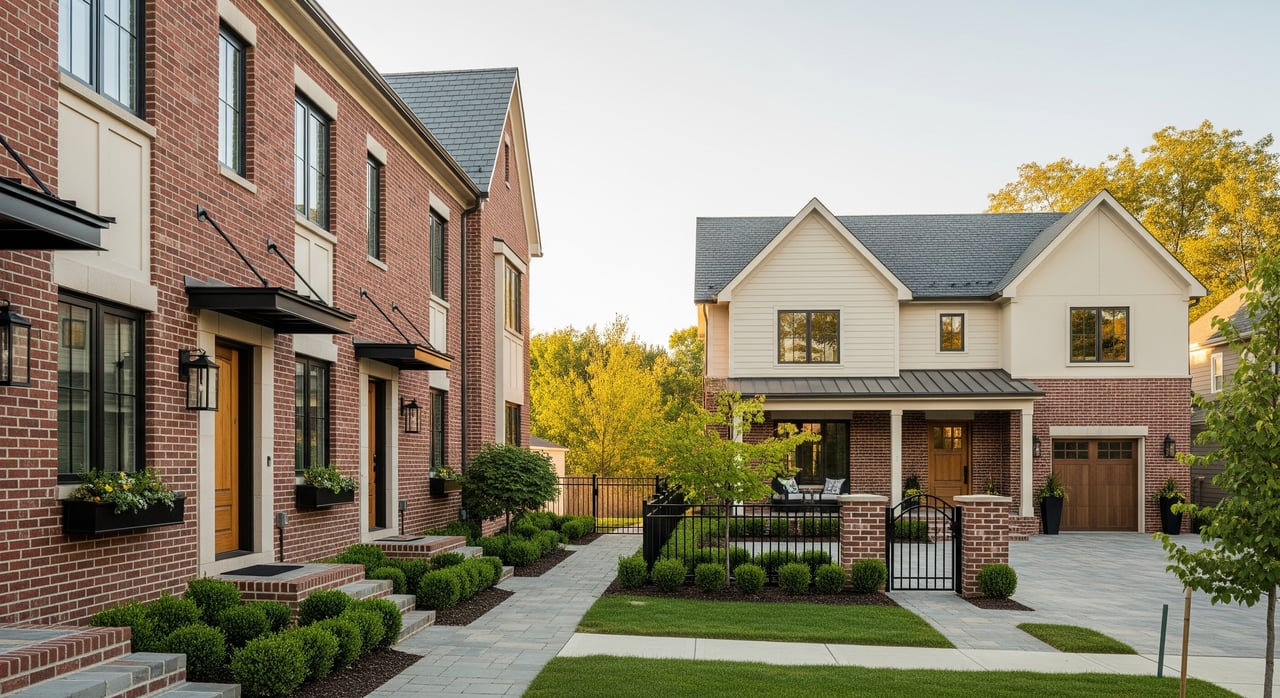
Trying to choose between a townhome and a single-family house in Independence? You are not alone. Many buyers in Kenton County weigh lower-maintenance living against more space and flexibility, and the right answer depends on how you live and what you value. In this guide, you will learn how costs, ownership, financing, lifestyle, and resale play out locally so you can move forward with clarity. Let’s dive in.
How the Independence market shapes your choice
Inventory and affordability influence your options. Townhomes often come with a lower purchase price, which can help you get into the area, while single-family homes typically command more and sit on larger lots. You will want to compare total monthly cost, not just the sale price, because townhomes usually include HOA dues and single-family homes do not.
Demand also differs by product type. Townhomes commonly appeal to first-time buyers, downsizers, and some investors. Single-family homes draw buyers who want yard space and more freedom to modify the property. These patterns affect how fast properties sell and what you can expect at resale.
What to watch locally
- Inventory and months of supply for each property type, since this impacts pricing power.
- Days on market and price-per-square-foot trends, which can signal buyer competition.
- New development in Kenton County, because it can add options and shape values over time.
Upfront cost: what you will pay to get the keys
Your upfront costs are more than a down payment. Plan for these line items when you compare townhomes and houses in Independence:
- Purchase price and down payment. Townhomes often start lower, which can shrink your down payment. If a townhome is fee simple, many lenders treat it like a house for underwriting. If it is within a condominium regime, additional project-level reviews can apply.
- Closing costs. Budget for lender fees, title insurance, appraisal, and recording costs. Some townhome communities also have transfer or initiation fees related to the association.
- Inspections. Both options benefit from a full home inspection. For townhomes, review the roof, shared walls, and common elements, plus the HOA documents.
- Association documents. Obtain and read the covenants, conditions and restrictions (CC&Rs), bylaws, budget, and reserve disclosures before you finalize your offer strategy.
Monthly cost: the total cost of living in Independence
Focus on your full monthly outlay to make an apples-to-apples comparison.
- Mortgage payment. Principal and interest based on your loan program, rate, and loan amount.
- HOA dues (townhomes). Townhome communities often have monthly or quarterly dues that may cover items like exterior maintenance, lawn care, snow removal, trash, and a master insurance policy. Coverage varies by community, so verify exactly what is included and what is not.
- Property taxes. In Kenton County, property taxes are tied to assessed value. Use the Property Valuation Administrator records for a specific parcel to estimate taxes rather than relying on neighborhood averages.
- Insurance. For a single-family house, you typically carry an HO-3 policy that covers the structure and your belongings. For a townhome, insurance depends on the legal setup. If it is a condominium regime with a master policy, you will likely carry an HO-6 policy for interior coverage and personal property. If it is fee simple, coverage can be more like a house policy. Ask your insurer to explain the boundary between the master policy and your policy so there are no gaps.
- Utilities. Check which utilities are individually metered. Some townhome communities have master meters for certain services that are tied to HOA dues, while houses are typically individually billed.
- Flood insurance when applicable. Parts of Kenton County have floodplain exposure. If a property sits in a special flood hazard area, a lender may require a separate flood policy. Always run the exact address through flood mapping and confirm coverage needs with your insurer.
Two quick scenarios to consider
- If you are comparing a lower-priced townhome with moderate HOA dues to a higher-priced single-family home, the total monthly cost might be closer than you expect once you add HOA, insurance, and taxes.
- If you prefer to minimize ongoing maintenance, a slightly higher monthly cost on a townhome could be worth it if the HOA covers exterior upkeep you would otherwise pay for or do yourself.
Ownership and maintenance: control vs convenience
Your maintenance responsibilities and flexibility differ between the two options.
- Townhome ownership. Responsibilities vary by community. Some cover the roof, siding, exterior, lawn care, snow removal, and trash. Others shift more of the exterior to the owner. Exterior changes often require written HOA approval. Review the CC&Rs, rules, and architectural guidelines before you plan projects.
- Single-family ownership. You usually have more freedom to modify your home and yard, subject to local zoning and any neighborhood rules. You are also responsible for all maintenance, which can mean higher time and cost but also more control.
A critical item for townhome buyers is reserve health. Ask for the most recent budget and reserve disclosures, and scan meeting minutes for special assessment history. Strong reserves and a clear maintenance plan help protect property values and reduce surprise costs.
Financing and insurance: how lenders and policies treat each type
Financing is straightforward for most single-family homes, since there is no project-level review. For townhomes, first confirm the legal structure:
- Fee simple townhome. Many lenders underwrite these similarly to single-family homes, and standard conventional loans are common.
- Condominium regime townhome. FHA and VA loans can be available only if the project meets approval requirements. Conventional loans may require a project questionnaire and review. Get clarity early to avoid delays.
Insurance follows the same pattern. Houses typically use an HO-3 policy. Townhomes in a condominium regime usually rely on a master policy plus an HO-6 for interior finishes and contents. Verify deductibles and match your coverage to the master policy. In our region, wind and hail deductibles can differ from all-peril deductibles, so ask your agent to explain both.
Lifestyle and location: fit for daily life in Independence
Think about your day-to-day routine and what you want from your home and neighborhood.
- Yard and outdoor living. If you want a larger private yard, a single-family home is often the better fit. If you prefer low-maintenance outdoor space, many townhomes offer small patios or decks maintained by the owner or HOA.
- Privacy and noise. Townhomes are attached, so shared walls come into play. Construction quality and layout matter. Single-family homes provide more separation by design.
- Commute and access. Independence residents commonly drive toward Cincinnati and other Northern Kentucky job centers. Access to KY-17, KY-16, and I-275 can shape your commute. Travel times vary with traffic, so evaluate the route you will use most often during peak hours.
- Parks, errands, and services. Proximity to the Independence business district, shopping, and parks can be a decision-maker. Consider how often you will walk, drive, or rideshare from your core destinations.
- Schools. Many areas are served by Kenton County Schools, but school zones can differ block by block. Always confirm the assigned school for a specific address using the district’s lookup and contact the district for the most current information.
Resale and demand: who is likely to buy after you
In Northern Kentucky, townhomes tend to attract first-time buyers, downsizers seeking low maintenance, and some investors. That means a broad entry-level buyer pool, but demand can hinge on HOA health and rules. Single-family homes often draw move-up buyers who want more space and a yard, and they may pay a premium for turnkey condition.
Your resale outcome will depend on supply, marketing, and preparation. For townhomes, a clean inspection report, strong association documents, and updated interiors help you compete. For single-family homes, curb appeal, yard condition, and recent mechanical upgrades can be just as important as interior finishes.
Three buyer snapshots for Independence
- First-time buyer commuting to Cincinnati. A townhome can reduce maintenance and upfront cost. Confirm whether the project is fee simple or a condominium regime, run the total monthly cost, and review commute routes during your typical drive time.
- Move-up household wanting a yard. A single-family home offers outdoor space, storage, and flexibility for projects. Factor in lawn care, exterior maintenance, and potential renovation plans.
- Downsizer simplifying life. A townhome with strong reserves and clear HOA coverage can trim maintenance tasks while keeping you close to amenities. Verify rules on pets, parking, and any rental restrictions.
Buyer checklist: townhome vs. house in Independence
- Confirm legal status for a townhome: fee simple vs. condominium regime.
- Ask for HOA documents: CC&Rs, bylaws, budget, reserve information, and recent meeting minutes.
- Verify total monthly cost: mortgage, HOA dues, taxes, insurance, and utilities.
- Request an insurance review to align your HO-3 or HO-6 coverage with any master policy.
- Check the specific address for floodplain exposure and any related insurance requirement.
- Confirm the assigned school zone directly with the district for the exact address.
- If you plan to rent in the future, review rental rules and any landlord registration requirements.
Seller tips: how listing strategy differs
- Know your buyer pool. Townhomes often appeal to first-time buyers and downsizers, so emphasize low maintenance, covered services, and updated interiors. Single-family homes draw buyers seeking space and yard, so highlight outdoor areas, storage, and recent system updates.
- Prepare your documents. Townhome sellers should gather CC&Rs, budget, reserve disclosures, and rules up front. Transparency builds trust and reduces friction.
- Stage for flow and light. Smaller townhome spaces benefit from clutter-free layouts and neutral finishes. Family homes benefit from staged outdoor living and clear room purpose, like a dedicated home office.
- Market the lifestyle. Showcase access to local routes, services, and parks. Strong media and wide digital exposure help you reach commuters and relocation buyers across the Cincinnati metro.
Your local advantage
If you want a calm, results-focused plan for buying or selling in Independence, our team can help you compare total cost of ownership, verify HOA details, and prepare a property to stand out. The Janell Stuckwisch Group combines agency-grade marketing with systemized execution, including professional media, targeted digital promotion, and turnkey staging and renovation coordination. With 1300-plus homes sold and a documented, repeatable process, we focus on speed, communication, and measurable outcomes.
Ready to talk through your next move in Independence or greater Kenton County? Connect with Janell Stuckwisch for a local plan that fits how you live and what you want from your investment.
FAQs
What is the main cost difference between a townhome and a house in Independence?
- Townhomes often start with a lower purchase price but add HOA dues, while single-family homes typically cost more upfront but do not include HOA dues, so compare total monthly cost.
What do HOAs in Independence typically cover for townhomes?
- Coverage varies by community but may include exterior maintenance, roof, lawn care, snow removal, trash, and a master insurance policy, so always verify specifics in the CC&Rs and budget.
Can I use an FHA or VA loan to buy a townhome in Kenton County?
- It depends on the townhome’s legal structure and project approval; fee-simple townhomes are often treated like houses, while condominium-regime townhomes may require project approval for FHA or VA.
How are property taxes calculated for homes in Kenton County?
- Taxes are based on assessed value for the specific parcel; use the county valuation records for a property-level estimate rather than relying on neighborhood averages.
Do I need flood insurance for a home in Independence?
- Only if the property sits in a mapped flood hazard area or your lender requires it; check the exact address on flood maps and confirm coverage details with your insurer.
Which is better for working from home, a townhome or a house?
- It depends on your space and noise preferences; a house usually offers more room and separation, while a townhome can work well if you plan for sound management and defined work zones.
As a seller, how should I prepare a townhome for the market?
- Gather HOA documents, address small repairs, refresh paint and lighting, and stage rooms for openness; clear, updated spaces and transparent HOA information build buyer confidence.